
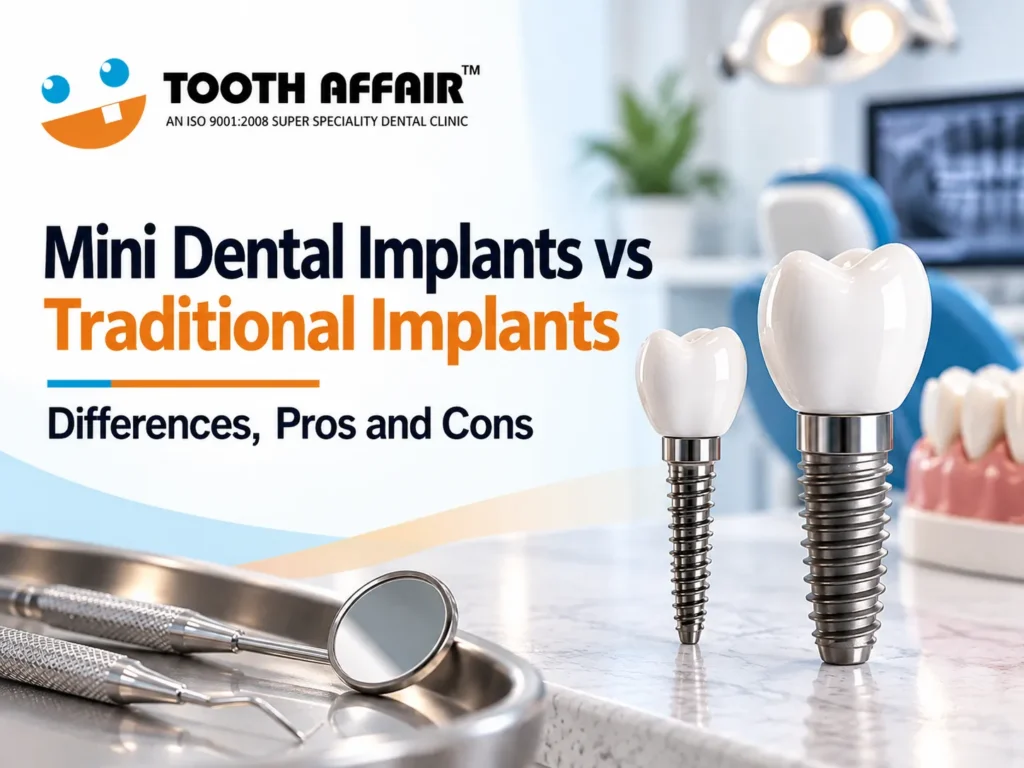
Replacing a missing tooth involves more than restoring your smile. The right implant should suit your jawbone, available space, bite, gum health, aesthetic needs, and long-term dental goals. This is why understanding Mini Dental Implants vs Traditional Implants matters before choosing a treatment. Mini implants have a smaller diameter and may be useful in selected cases involving narrow spaces, reduced ridge width, or denture stabilization. Traditional implants are larger and offer broad restorative applications. But which option is appropriate for you? In this guide, we explain the key differences, advantages, disadvantages, safety, pain, recovery, costs, and factors to discuss with your dentist before treatment.
Differences Between Mini Dental Implants vs Traditional Implants: Definitions, Pros and Cons
Dental implants provide a stable foundation for replacing missing teeth. However, not all implants are designed in the same way.
The most obvious difference between Mini Dental Implants vs Traditional Implants is their diameter. However, size is only one part of the comparison. Implant design, bone requirements, chewing forces, tooth location, restoration type, surgical approach, and long-term maintenance can also differ.
Mini dental implants are narrower than conventional implants and may be useful in selected cases where available space or ridge width is limited. They are also commonly discussed as an option for stabilizing certain removable dentures.
Traditional dental implants generally have a larger diameter and are used across a broad range of restorative situations, including single-tooth replacement, multiple missing teeth, bridges, and selected full-arch treatments.
The important point is simple: there is no universal implant that is right for every patient. The most appropriate option depends on your individual dental condition and treatment goals.
What are Mini Dental Implants?
Mini dental implants are narrow-diameter dental implants designed for specific clinical applications. Their smaller size can make them useful in selected situations involving limited space, narrow ridges, or denture stabilization.
The exact definition can vary between implant systems and classification methods. The ITI describes implants below 3 mm in diameter as mini-implants and separately categorizes narrow-diameter implants within a broader range.
Their smaller diameter can be helpful when the available space is limited or when the jaw ridge is relatively narrow. They can also be used in selected denture-stabilization treatments.
However, a mini implant should not simply be viewed as a smaller version of a traditional implant. The smaller diameter changes its mechanical characteristics, which means the dentist must carefully consider the amount of force the implant will experience.
What are the Key Features of Mini Dental Implants?
Mini dental implants are characterized by their narrow diameter, selected clinical applications, and potential usefulness where conventional implant placement may be challenging because of limited space or ridge width. Let’s explore these features in more detail:
- Smaller Diameter: Mini implants are narrower than conventional dental implants, allowing them to be considered in selected areas where space is limited.
- Narrow-Ridge Application: Their smaller size may allow placement in certain narrow ridges where a larger implant may require additional treatment.
- Denture Stabilization: Mini implants can be used in selected cases to help stabilize removable dentures and improve their retention.
- Less Extensive Surgery in Selected Cases: Depending on the patient’s anatomy and implant system, placement may involve a less extensive surgical approach.
- One-Piece Design in Some Systems: Some mini implant systems combine the implant and abutment into a single component.
- Specific Clinical Indications: Mini implants are not suitable for every missing tooth. Their use depends on the location, available bone, restoration, and expected chewing forces.
- Mechanical Considerations: Their smaller diameter means that mechanical strength must be carefully considered, particularly in areas exposed to higher forces.
What are the Pros of Mini Dental Implants?
Mini dental implants can offer practical benefits for carefully selected patients, particularly when space or ridge width is limited or when denture stabilization is the primary treatment objective. Let’s explore the main advantages:
- May Require Less Bone Width: Their smaller diameter can be useful when the ridge is too narrow for certain conventional implants.
- Potentially Less Invasive Treatment: In appropriately selected cases, a smaller implant may allow a less extensive surgical procedure.
- Useful for Denture Stabilization: Mini implants can provide additional retention for selected implant-supported overdentures.
- Suitable for Certain Narrow Spaces: Their smaller size may be advantageous when the space between adjacent teeth is restricted.
- Potentially Shorter Treatment Process: Some cases can be completed with fewer surgical steps, although the actual timeline varies from patient to patient.
- May Reduce the Need for Certain Augmentation Procedures: When ridge width is the primary limitation, a narrow implant may sometimes avoid or reduce the need for lateral bone augmentation.
What are the Cons of Mini Dental Implants?
Mini dental implants have limitations that should be considered carefully, particularly when high chewing forces, extensive restorations, or challenging anatomical conditions are involved. Here are the key disadvantages to understand:
- Not Suitable for Every Patient: Mini implants have specific indications and should not automatically replace conventional implants.
- Lower Mechanical Reserve: Their smaller diameter can create greater mechanical demands on the implant, particularly in high-load areas.
- May Not Be Ideal for Molars: Back teeth experience substantial chewing forces, so implant selection requires careful biomechanical planning.
- Limited Application in Some Situations: Evidence and clinical indications vary depending on implant diameter, design, and treatment type.
- May Not Eliminate Bone Grafting: A narrow implant can help in selected narrow-ridge cases, but it does not eliminate the need for augmentation in every patient.
- Maintenance Is Still Necessary: Mini implants require proper oral hygiene, professional monitoring, and appropriate maintenance.
What are Traditional Implants?
Traditional dental implants are generally larger-diameter implants used for a wide range of tooth-replacement procedures. They can support crowns, bridges, and selected implant-supported full-arch or overdenture restorations.
A conventional implant commonly involves an implant fixture placed into the jawbone, a separate abutment, and a final dental restoration.
The restoration may be a crown for one missing tooth, a bridge for several missing teeth, or another implant-supported prosthesis.
Traditional implants have been used extensively in implant dentistry and offer considerable flexibility in treatment planning.
They can be considered for:
- Single missing teeth
- Multiple missing teeth
- Posterior teeth
- Implant-supported bridges
- Selected full-arch restorations
Their larger diameter can provide greater mechanical strength compared with narrower implants, although implant size must still be matched to the patient’s anatomy.
What are the Key Features of Traditional Implants?
Traditional implants are larger, versatile implant systems designed to support a broad range of dental restorations and functional requirements. Let’s look at their important features:
- Larger Diameter: Traditional implants generally have a larger diameter than mini implants, providing greater structural dimensions.
- Two-Piece Design: Many conventional implant systems use a separate implant fixture and abutment.
- Broad Restorative Applications: They can be used for single crowns, bridges, multiple missing teeth, and selected full-arch treatments.
- Strong Mechanical Characteristics: Their larger diameter provides greater cross-sectional material, which can be advantageous when managing chewing forces.
- Multiple Implant Sizes: Dentists can choose from different implant lengths and diameters according to the patient’s anatomy.
- Extensive Clinical Use: Conventional implants have been used for many years across a wide range of treatment situations.
- Restorative Flexibility: Separate components can provide dentists with flexibility when positioning and designing the final restoration.
What are the Pros of Traditional Implants?
Traditional implants provide broad treatment versatility, strong mechanical support, and considerable restorative flexibility, making them suitable for many single-tooth, multiple-tooth, and selected full-arch applications. Let’s explore the main advantages:
- Broad Range of Applications: Traditional implants can be used for many different tooth-replacement situations.
- Strong Mechanical Support: Their larger diameter can provide greater resistance to certain mechanical stresses.
- Suitable for Posterior Teeth: Conventional implants are commonly considered when replacing teeth that experience significant chewing forces.
- Flexible Restoration Options: They can support crowns, bridges, and selected full-arch restorations.
- Extensive Clinical Evidence: Conventional implants have a substantial history of clinical use and research.
- Potentially Long-Term Solution: With appropriate treatment planning, oral hygiene, professional maintenance, and healthy surrounding tissues, implants can provide long-term tooth replacement.
What are the Cons of Traditional Implants?
Traditional implants offer broad applications but may require greater bone dimensions, additional procedures, more extensive treatment planning, and a higher overall investment in some clinical situations. Here are the main considerations:
- Greater Bone Requirements in Some Cases: A larger implant may require adequate ridge dimensions for placement.
- Bone Augmentation May Be Necessary: Patients with significant bone loss may require grafting or another augmentation procedure.
- Treatment Can Be More Involved: Some cases require several stages, particularly when additional surgical procedures are necessary.
- Higher Overall Cost in Some Cases: The complete treatment cost can increase when additional procedures or complex restorations are required.
- Recovery May Be More Extensive: This is particularly relevant when implant placement is combined with bone grafting or other surgical procedures.
- Not Automatically Suitable for Everyone: Conventional implants also require proper diagnosis and treatment planning.
What are the Top 10 Key Differences Between Mini Dental Implants vs Traditional Implants?
Understanding the difference between Mini Dental Implants vs Traditional Implants becomes easier when you compare the two options across the factors that actually affect treatment.
Implant Size and Diameter
Mini dental implants have a smaller diameter than traditional implants.
The ITI describes implants below 3 mm as mini-implants and classifies narrow-diameter implants more broadly.
A smaller diameter can be advantageous where the ridge or available space is narrow. However, implant diameter also affects mechanical strength.
Traditional implants are generally wider and provide a larger structural foundation.
The appropriate diameter should therefore be selected according to the available bone and the restoration that the implant needs to support.
Implant Design and Structure
Mini implants may use a one-piece configuration, depending on the system.
Traditional implants commonly use a two-piece configuration consisting of the implant fixture and a separate abutment.
This can influence restorative flexibility.
A two-piece implant system may allow the dentist greater flexibility in positioning and restoring the implant, while certain one-piece designs can simplify the component structure.
The actual design depends on the manufacturer and implant system.
Bone Requirements
Bone availability is one of the most important considerations.
A narrow ridge may make placement of a conventional implant difficult without augmentation.
A narrow-diameter implant may sometimes fit within the available ridge width and reduce the need for certain augmentation procedures.
However, this does not mean that mini implants are a universal solution for bone loss.
Your dentist must assess bone width, height, quality, and the position of important anatomical structures.
Treatment and Placement Procedure
The surgical approach can vary significantly between patients.
A straightforward mini implant procedure may be less extensive in selected cases.
Traditional implant placement can also be relatively straightforward when sufficient bone is available.
However, if bone grafting or another preparatory procedure is required, the treatment can become more involved.
Therefore, it is inaccurate to say that every mini implant is quick and every traditional implant requires extensive surgery.
The actual procedure depends on the patient’s anatomy and treatment plan.
Healing and Recovery Time
Recovery is another area where patients often expect a simple comparison.
In reality, healing varies.
Factors that influence recovery include:
- Number of implants
- Surgical technique
- Bone condition
- Implant location
- Whether bone grafting was performed
- Individual healing response
- Loading protocol
A straightforward narrow-diameter implant procedure may involve less postoperative disruption in selected cases.
However, your dentist should provide a personalized estimate rather than promising a fixed recovery period.
Strength and Chewing Capacity
Chewing forces are different throughout the mouth.
Front teeth and back teeth perform different functions, and molars generally experience considerable forces.
Because mini implants are narrower, their mechanical characteristics differ from those of larger implants.
The ITI identifies mechanical complications, including fracture risk, as an important consideration when using narrow-diameter implants.
This does not mean that mini implants are weak or unsuitable.
It means they need to be used in situations where their mechanical properties are appropriate.
Suitable Dental Applications
Mini implants may be considered for:
- Denture stabilization
- Narrow anterior spaces
- Certain small-tooth replacement cases
- Selected narrow-ridge situations
Traditional implants may be considered for:
- Single-tooth replacement
- Multiple missing teeth
- Bridges
- Posterior teeth
- Selected full-arch restorations
The suitability depends on the specific implant system and patient’s clinical condition.
Cost of Treatment
The cost of dental implants varies considerably between patients.
Factors can include:
- Implant brand
- Dentist’s expertise
- Diagnostic imaging
- Number of implants
- Crown material
- Laboratory charges
- Bone grafting
- Other surgical procedures
- Complexity of restoration
For this reason, it is better to compare the total treatment cost rather than the price of the implant fixture alone.
A lower initial implant price does not necessarily mean a lower overall treatment cost.
Aesthetic and Restoration Options
The final restoration is just as important as the implant underneath it.
For front teeth, the dentist must consider tooth shape, gum contour, neighboring teeth, smile line, and available space.
Traditional implant systems may offer considerable restorative flexibility because the implant and abutment can be separate components.
Mini implants can also produce functional and aesthetic restorations in appropriately selected cases, but the options depend on the specific system.
Long-Term Maintenance and Durability
Both implant types require long-term maintenance.
You will still need:
- Regular brushing
- Interdental cleaning
- Professional dental examinations
- Gum-health monitoring
- Periodic restoration assessment
Implant success depends on many factors beyond implant diameter.
These include oral hygiene, smoking, gum health, bone condition, implant position, bite forces, restoration design, and ongoing maintenance.
Mini Dental Implants vs Traditional Implants: Quick Comparison
| Factor | Mini Dental Implants | Traditional Implants |
| Diameter | Smaller/narrower | Generally wider |
| Design | Often one-piece in some systems | Commonly two-piece |
| Narrow spaces | Useful in selected cases | May require more space |
| Narrow ridge | May be useful | May require augmentation |
| Denture stabilization | Common application | Also possible |
| Single tooth | Selected cases | Broad application |
| Posterior teeth | Requires careful selection | Commonly considered |
| Mechanical characteristics | Greater limitations with smaller diameter | Generally greater mechanical reserve |
| Surgery | May be less extensive in selected cases | Varies by case |
| Bone grafting | May reduce need in selected situations | May be required when bone is inadequate |
| Restoration flexibility | Depends on system | Generally broad |
| Cost | Case-dependent | Case-dependent |
| Recovery | Case-dependent | Case-dependent |
| Maintenance | Required | Required |
Which One Should You Focus On First? Point-Wise Explanation
The best starting point is not the implant itself. Start with the dental problem you want to solve, then evaluate which implant design can safely and effectively address it.
Focus on Mini Dental Implants First if:
Mini dental implants may be worth discussing when the treatment site is narrow, denture stabilization is required, or a selected lower-load application makes a narrow implant appropriate. Let’s look at these situations:
- You Have a Narrow Implant Site: A smaller implant may be considered where the available ridge width is limited.
- You Need Denture Stabilization: Mini or narrow-diameter implants may be useful for selected overdenture treatments.
- You Have a Selected Anterior Tooth Case: Certain narrow implants can be considered for specific front-tooth replacement situations.
- You Want to Explore Less Extensive Surgical Options: If your main limitation is ridge width, a narrow implant may sometimes reduce the need for certain augmentation procedures.
- Your Dentist Confirms Suitable Loading Conditions: A mini implant must be capable of handling the forces generated by the planned restoration.
Focus on Traditional Implants After Mini Dental Implants is Strong if:
Traditional implants may be more appropriate when the treatment involves higher chewing forces, greater restorative demands, or a need for broader conventional implant options. Here are the main situations:
- The Missing Tooth is Exposed to Significant Chewing Forces: This can be particularly relevant for molars.
- You Require Greater Restorative Flexibility: Conventional systems can provide numerous options for restoration design.
- You Have Sufficient Bone: A conventional implant may be appropriate when the anatomy supports it.
- You Need Multiple Teeth Replaced: Traditional implants can be used across many multiple-tooth treatment plans.
- The Restoration Requires Substantial Mechanical Support: A larger implant may provide a greater mechanical reserve.
- You Have Significant Clenching or Grinding: Your dentist may need to account for increased forces when choosing implant size and design.
The Ideal Strategy to Choose the Best Dental Implants
Choosing between mini and traditional implants should be a structured clinical decision rather than a simple price comparison.
Evaluate Your Bone Condition
Your dentist may recommend dental X-rays or 3D imaging such as CBCT when appropriate.
Imaging can help evaluate:
- Bone height
- Bone width
- Bone anatomy
- Nerve position
- Sinus location
- Relationship with neighboring teeth
This information helps determine whether there is sufficient bone for the planned implant.
Consider the Location of the Missing Tooth
A missing front tooth and a missing molar do not have identical functional requirements.
Front teeth involve significant aesthetic considerations.
Back teeth generally experience higher chewing forces.
The implant must therefore be selected according to the specific location.
Understand Your Bite and Chewing Forces
Your bite can influence implant selection.
If you grind or clench your teeth, the mechanical load placed on the restoration may be higher.
Your dentist should consider these forces before selecting a narrow implant.
Compare the Complete Treatment Cost
Do not compare only the implant fixture price.
Ask for the complete cost, including:
- Consultation
- Imaging
- Implant
- Abutment
- Crown
- Temporary restoration
- Bone grafting if required
- Other surgical procedures
- Follow-up care
This provides a more realistic financial comparison.
Discuss the Long-Term Treatment Plan
Ask your dentist what happens after the implant is placed.
Find out:
- How often you need follow-up visits
- How to clean the implant
- What foods to avoid during healing
- When the final crown will be placed
- What warning signs require attention
- How the restoration will be maintained
A successful implant is not simply one that gets placed successfully. It should also remain functional and maintainable over time.
Does Getting a Dental Implant Hurt?
Dental implant placement is normally performed using local anesthesia, so patients generally should not experience sharp pain during the procedure, although pressure and vibration may be noticeable.
You may feel:
- Pressure
- Vibration
- Movement
- Pulling or pushing sensations
After the anesthesia wears off, some soreness, swelling, or tenderness can occur.
The intensity varies depending on the procedure.
A straightforward implant placement may cause relatively limited postoperative discomfort, while procedures involving bone grafting or more extensive surgery may produce more swelling or soreness.
Your dentist can recommend appropriate pain-management measures based on your medical history.
If pain becomes severe, gets worse rather than better, or is accompanied by other concerning symptoms, contact your dentist promptly.
Are Mini Dental Implants Less Painful Than Traditional Implants?
Mini implants may involve a less extensive surgical approach in selected patients, potentially reducing postoperative disruption, but pain varies significantly according to the individual procedure and healing response.
Pain depends on several factors, including:
- Surgical technique
- Number of implants
- Location
- Bone condition
- Bone grafting
- Individual pain sensitivity
- Healing response
Therefore, it is not accurate to promise that mini implants will always be painless or significantly less painful.
The important factor is the overall complexity of your treatment.
Are Dental Implants Safe?
Dental implants are an established method of tooth replacement, but no surgical treatment is completely risk-free. Proper diagnosis, treatment planning, sterile technique, and professional follow-up are important parts of safe implant treatment.
Potential complications can include:
- Infection
- Bleeding
- Swelling
- Temporary discomfort
- Implant failure
- Damage to nearby anatomical structures
- Gum or bone problems
- Mechanical complications
- Restoration-related complications
The risk depends on the patient’s health, anatomy, oral hygiene, surgical technique, implant position, and other factors.
Are Mini Dental Implants Safe?
Mini dental implants can be safe and effective when appropriately selected and placed by a qualified dental professional. Their safety depends on suitable bone, proper positioning, appropriate loading, and careful treatment planning.
The dentist needs to determine whether:
- There is adequate bone
- The implant can achieve appropriate stability
- The implant is suitable for the restoration
- The expected chewing forces are acceptable
- The implant’s design is appropriate
- The patient can maintain good oral hygiene
Narrow-diameter implants have recognized clinical applications, but their mechanical limitations and specific indications need to be considered.
What are the Possible Risks of Dental Implants?
Dental implants generally have predictable outcomes when appropriately planned, but potential surgical, biological, and mechanical complications should be discussed before treatment. Here are some risks patients should understand:
Infection
Bacterial infection can affect the tissues around an implant. Maintaining good oral hygiene and following postoperative instructions can help reduce complications.
Implant Failure
An implant may fail to integrate properly with the bone or may develop problems later.
Mechanical Complications
Components can sometimes loosen, fracture, or experience other mechanical problems.
Narrow implants require particular attention to mechanical loading because their smaller diameter can increase certain biomechanical risks.
Nerve-Related Problems
Implant placement near important nerves requires careful planning. Imaging is particularly important in areas where anatomical structures are close to the planned implant site.
Sinus-Related Complications
Implants placed in the upper back jaw may require careful assessment of the sinus area.
Gum and Bone Problems
Inflammation around implants can affect supporting tissues.
This is why long-term maintenance is essential.
How Long Does Recovery Take After Dental Implant Placement?
Recovery varies from patient to patient and depends on implant location, surgical complexity, bone grafting, number of implants, and individual healing.
You may experience swelling or tenderness during the initial healing period.
Your dentist will tell you when you can resume normal eating, brushing, exercise, and other activities.
Do not compare your recovery directly with another patient’s experience.
Two people can undergo apparently similar implant procedures and have different healing experiences.
Can Mini Dental Implants Be Used for Dentures?
Yes. Mini or narrow-diameter implants can be used in selected denture-stabilization treatments to provide additional retention and improve the stability of an appropriately designed overdenture.
A removable denture can sometimes move during speaking and chewing.
Implant-supported overdentures use implants to provide additional retention and stability.
However, the dentist must assess the patient’s bone, denture design, oral health, and treatment requirements before recommending the approach.
Can Mini Dental Implants Be Used for Molars?
A mini implant is not automatically suitable for a molar because molars experience substantial chewing forces and therefore require careful consideration of implant diameter, mechanical strength, bone condition, bite, and restoration design.
Some narrow implant systems have specific limitations regarding high-load or molar applications.
Therefore, you should not assume that a mini implant can replace every missing molar.
Your dentist should evaluate the site, bite, bone, and restoration before recommending an implant.
Can You Switch From Mini Dental Implants to Traditional Implants Later?
A change in implant treatment may sometimes be possible, but it cannot be guaranteed because the feasibility depends on bone condition, implant position, integration, available space, gum health, and the reason for changing treatment.
The possibility depends on:
- Bone condition
- Existing implant position
- Implant integration
- Available space
- Gum health
- Restoration
- Reason for changing treatment
It is better to choose the appropriate implant strategy from the beginning rather than assuming you can easily switch later.
How Much Do Mini Dental Implants and Traditional Implants Cost in Bangalore?
Dental implant costs in Bangalore vary according to the implant system, dentist, restoration, diagnostic requirements, surgical complexity, and whether additional procedures are needed.
The final cost can vary depending on:
- Implant brand
- Dentist
- Clinic
- Number of implants
- Crown material
- Diagnostic imaging
- Bone grafting
- Surgical complexity
- Laboratory charges
- Restoration type
Patients should therefore avoid comparing clinics solely on the advertised implant price.
A better question is:
“What is the complete cost of my implant treatment from diagnosis to final crown?”
That approach makes comparisons much more meaningful.
How Can You Prepare for Dental Implant Treatment?
Preparation starts with an accurate diagnosis. Your dentist may evaluate your medical history, oral health, gums, bone, bite, existing teeth, and implant site before developing a treatment plan.
Before treatment, your dentist may assess your:
- Medical history
- Dental history
- Gum health
- Existing teeth
- Bone condition
- Bite
- Smoking or tobacco use
- Oral hygiene
Your dentist may also recommend imaging.
If you have existing dental infections, gum disease, or other oral health problems, these may need to be addressed before implant placement.
Follow all preoperative instructions provided by your dental team.
What Should You Avoid After Dental Implant Surgery?
Your dentist will provide personalized postoperative instructions based on your procedure, and these instructions should take priority over general online advice.
Depending on the procedure, you may be advised to avoid:
- Smoking or tobacco
- Excessive physical activity immediately after surgery
- Disturbing the surgical area
- Hard or difficult-to-chew foods during early healing
- Poor oral hygiene
Do not rely on generic online advice when your dentist has given you specific instructions.
How Can You Maintain Dental Implants for the Long Term?
Long-term implant care depends on consistent oral hygiene, professional monitoring, and protecting the implant-supported restoration from excessive forces.
Brush Regularly
Clean your teeth and implant-supported restoration according to your dentist’s instructions.
Clean Between Teeth
Interdental cleaning is important because plaque can accumulate around implant-supported restorations.
Attend Dental Checkups
Regular professional examinations allow your dentist to monitor the implant and surrounding tissues.
Protect Your Implant From Excessive Forces
If you grind or clench your teeth, discuss this with your dentist.
Avoid Tobacco
Smoking and tobacco use can negatively affect oral health and implant outcomes.
Report Problems Early
Contact your dentist if you notice:
- Implant movement
- Persistent pain
- Swelling
- Bleeding
- Pus or discharge
- Changes in your bite
- A loose crown or component
Early evaluation can prevent a minor problem from becoming a more complicated one.
Why Does a Personalized Dental Implant Consultation Matter?
Online research can help you understand your options, but only a dental examination can determine whether a mini or traditional implant is appropriate for your particular anatomy, oral health, bite, and restoration requirements.
Two patients may both have one missing tooth but require completely different treatment plans.
One may have:
- Adequate bone
- Healthy gums
- Good spacing
- Low bite forces
Another may have:
- Bone loss
- A narrow ridge
- Gum disease
- Bruxism
- Limited space
Their implant options may therefore be completely different.
That is why the best way to approach Mini Dental Implants vs Traditional Implants is to use online information to prepare questions—not to self-diagnose.
Conclusion
The choice between Mini Dental Implants vs Traditional Implants depends on your individual dental anatomy, missing-tooth location, bone condition, bite forces, restoration requirements, aesthetic expectations, budget, and long-term treatment goals. Mini dental implants can be useful in selected cases, particularly where space or ridge width is limited or where denture stabilization is required. Traditional implants, meanwhile, offer broad restorative applications and may provide greater mechanical and prosthetic flexibility in many situations.
The key is not to choose an implant simply because it is smaller, cheaper, faster, or more convenient. Your dentist should evaluate your mouth, explain the available options, discuss the potential benefits and risks, and recommend a treatment plan based on your specific needs.
Get Professional Dental Implants with Tooth Affair
Choosing dental implants is a long-term decision, so getting a proper clinical evaluation is essential.
If you are considering mini dental implants, traditional dental implants, or other tooth-replacement options in Bangalore, Tooth Affair can help you explore suitable dental treatment options based on your individual requirements.
Visit Tooth Affair to learn more about dental treatments in Bangalore and schedule a professional consultation.
FAQs About Mini Dental Implants vs Traditional Implants
Are Mini Dental Implants Less Painful Than Traditional Implants?
Mini dental implant placement may involve a less extensive surgical procedure in selected cases, potentially reducing postoperative discomfort, but pain varies according to the procedure, patient, and healing response.
Are Mini Dental Implants Safe?
Mini dental implants can be safe when appropriately selected and professionally placed, but their suitability depends on bone, implant position, chewing forces, restoration type, oral hygiene, and individual clinical conditions.
How Long Does It Take to Recover From Dental Implant Surgery?
Recovery varies according to the implant procedure, with straightforward cases generally involving less postoperative disruption than procedures requiring bone grafting or other additional surgical treatment.
Which Is Stronger: Mini Dental Implants or Traditional Implants?
Traditional implants generally have a larger diameter and greater cross-sectional material, giving them a different mechanical strength profile, while mini implants can perform well when appropriately selected.
Can Mini Dental Implants Be Used for Loose Dentures?
Yes. Mini or narrow-diameter implants can be used in selected denture-stabilization treatments to provide additional retention and improve the stability of an appropriately designed overdenture.
Can Mini Dental Implants Be Used for Molars?
Mini implants are not automatically appropriate for molars because these teeth experience substantial chewing forces, making implant diameter, bone, bite, and restoration design important considerations.
Do Mini Dental Implants Require Bone Grafting?
Not always. Their smaller diameter may help in selected narrow-ridge cases, but mini implants do not eliminate the need for bone grafting when the available bone is inadequate.
Can Dental Implant Surgery Damage a Nerve?
Nerve-related complications are possible but uncommon, and careful examination and appropriate imaging help the dentist assess the relationship between the planned implant site and nearby nerves before treatment.
Is Dental Implant Surgery Completely Painless?
The procedure is normally performed under local anesthesia, so sharp pain should generally be controlled during placement, although pressure or vibration may be felt and some soreness can occur afterward.
How Do I Know Which Implant Is Right for Me?
The appropriate implant depends on your bone, gums, bite, missing-tooth location, available space, restoration requirements, overall oral health, and long-term treatment goals, so professional evaluation is essential.