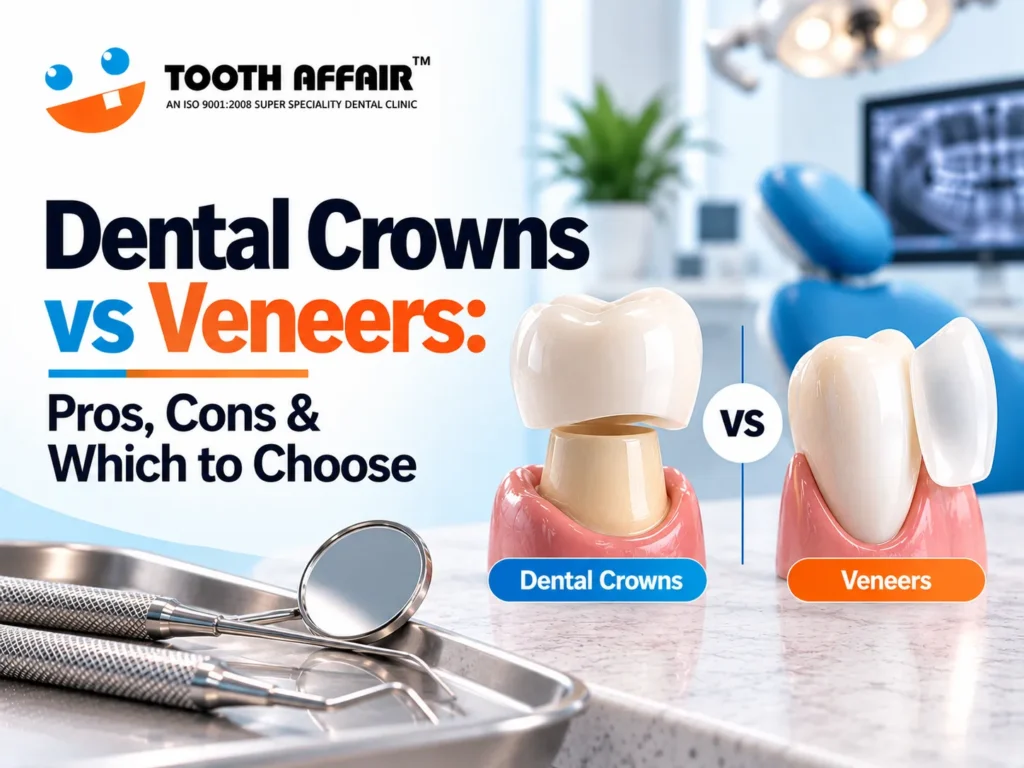
Dental crowns and veneers are two popular dental treatments for improving the appearance of teeth and restoring a confident smile. Although both can enhance the shape, color, and overall appearance of teeth, they serve different purposes. Dental crowns cover the entire visible portion of a tooth, while veneers cover primarily the front surface.
Choosing between dental crowns vs veneers depends on several factors, including your tooth condition, oral health, cosmetic goals, bite, budget, and the amount of natural tooth structure that needs protection. Crowns are generally recommended for weakened, heavily restored, or significantly damaged teeth. Veneers are often suitable for improving discoloration, minor chips, uneven edges, and other cosmetic concerns affecting otherwise healthy teeth.
Understanding their differences can help you discuss the available options with your dentist and make an informed decision. This guide compares dental crowns and veneers based on coverage, appearance, procedure, durability, cost, maintenance, suitability, and long-term considerations.
Dental Crowns vs Veneers: Definitions, Pros and Cons
The primary difference between dental crowns and veneers is the amount of tooth coverage and the purpose of the treatment. Crowns cover the entire visible portion of a prepared tooth to restore its strength, shape, and function. Veneers cover the front surface to improve appearance while preserving more of the natural tooth structure in suitable cases.
Both treatments can be customized to match the color and shape of your natural teeth. However, they are not interchangeable. A crown may be more appropriate for a structurally weakened tooth, while a veneer may be suitable for a healthy tooth with cosmetic imperfections.
The dentist will evaluate the condition of your teeth, gums, bite, and existing restorations before recommending either treatment.
What Are Dental Crowns?
Dental crowns are custom-made restorations that fit over a prepared tooth, covering its entire visible portion above the gumline. They are designed to restore the tooth’s shape, size, strength, and appearance.
Dentists commonly recommend crowns for teeth that have lost substantial structure because of decay, fractures, large fillings, or certain previous treatments. Crowns can also be used to restore dental implants or support other restorative treatment plans.
A crown may be recommended when a tooth needs more coverage and reinforcement than a filling or veneer can provide.
Common reasons for choosing dental crowns include:
- Restoring a severely damaged or weakened tooth.
- Protecting a tooth after root canal treatment when full coverage is clinically appropriate.
- Restoring a tooth with a large filling and limited remaining structure.
- Improving the shape or appearance of a significantly worn tooth.
- Restoring a dental implant.
- Supporting certain dental bridges.
- Improving the appearance of a tooth that cannot be adequately restored with a more conservative option.
What Materials Are Used for Dental Crowns?
The appropriate crown material depends on the tooth’s location, bite pressure, aesthetic requirements, available tooth structure, and budget.
- Porcelain: Offers a natural appearance and may be suitable for visible teeth.
- Porcelain-fused-to-metal (PFM): Combines a metal framework with a porcelain outer layer.
- Zirconia: A strong ceramic material available in different formulations and translucencies.
- Metal alloys: Can provide excellent durability, particularly for back teeth, although their metallic appearance may not suit every patient.
- Other dental ceramics: Certain ceramic materials may be selected for their appearance and mechanical properties.
Your dentist can explain the advantages and limitations of each material based on your specific tooth and bite.
What Are the Pros of Dental Crowns?
Dental crowns offer several benefits when a tooth needs additional protection, structural support, or a complete restoration. The advantages depend on the tooth’s condition, the crown material, and the treatment plan.
- Provides full coverage: A crown covers the entire visible portion of a prepared tooth, helping restore its shape and function.
- Restores weakened teeth: Crowns can help protect teeth that have lost substantial structure because of decay, fractures, or large fillings.
- Improves appearance: Tooth-colored materials, such as porcelain and zirconia, can provide a natural-looking result when properly designed.
- Supports chewing function: A well-fitted crown can help restore comfortable biting and chewing when the tooth is suitable for treatment.
- Offers several material options: Patients may choose from ceramic, zirconia, porcelain-fused-to-metal, and metal alloy crowns based on their needs and budget.
- Can last for many years: With proper oral hygiene, regular dental checkups, and appropriate care, crowns can provide long-term restoration.
- Works in different restorative treatments: Crowns may be used to restore natural teeth, replace the visible portion of dental implants, or support certain dental bridges.
What Are the Cons of Dental Crowns?
Although dental crowns can restore damaged teeth, they also have limitations. Understanding these considerations can help you discuss whether a crown is the right option for your dental needs.
- Requires tooth preparation: Placing a crown generally involves reshaping the tooth to create enough room for the restoration.
- May cause temporary sensitivity: Some patients experience sensitivity or gum tenderness after the procedure.
- Can be relatively expensive: The cost depends on the crown material, clinic, laboratory work, and additional treatment required.
- May chip, crack, or loosen: Crowns can become damaged or dislodged, particularly when exposed to excessive bite pressure or teeth grinding.
- Does not prevent decay underneath: The natural tooth around the crown’s edges can still develop decay if plaque accumulates or oral hygiene is inadequate.
- May require replacement: Crowns do not last forever and may eventually need repair or replacement.
- May affect the opposing tooth: Certain materials and restoration designs can contribute to wear on opposing teeth if the bite and surface are not properly managed.
A crown is not always necessary for every damaged tooth. Your dentist may recommend a filling, onlay, or another more conservative treatment if it can adequately restore the tooth.
What Are Dental Veneers?
Dental veneers are thin, custom-made coverings bonded to the front surface of teeth. They are primarily used to improve the appearance of teeth with cosmetic concerns such as discoloration, small chips, uneven edges, minor shape irregularities, or selected gaps.
Veneers can help create a more uniform smile by adjusting the visible color, shape, size, and proportions of suitable teeth.
Unlike crowns, veneers do not cover the entire tooth. They generally preserve more natural tooth structure, although many conventional veneers require some enamel removal to achieve an appropriate fit and appearance.
Veneers are not suitable for every patient. Teeth with extensive decay, significant fractures, insufficient enamel, or certain bite problems may require another treatment approach.
Common reasons for choosing veneers include:
- Improving the appearance of stained or discolored teeth.
- Correcting minor chips and uneven edges.
- Making selected teeth appear more uniform in shape.
- Improving the appearance of small gaps between teeth.
- Addressing minor cosmetic irregularities.
- Creating a more consistent appearance across the visible front teeth.
What Materials Are Used for Dental Veneers?
The two common veneer materials are porcelain and composite resin.
- Porcelain veneers: Custom-made ceramic restorations that can closely resemble natural enamel. They are generally stain-resistant and can provide long-lasting aesthetic results.
- Composite resin veneers: Made using tooth-colored resin applied directly or indirectly to the teeth. They can be more affordable and may require less preparation in selected cases, but they are generally more prone to staining, wear, or chipping than porcelain veneers.
The material and technique should be selected according to your oral health, cosmetic expectations, bite, and the amount of tooth preparation required.
What Are the Pros of Dental Veneers?
Dental veneers are primarily designed to improve the appearance of teeth. They can be a suitable option for patients who want to address cosmetic concerns while preserving as much natural tooth structure as possible.
- Enhances smile appearance: Veneers can improve the visible color, shape, size, and proportions of selected teeth.
- Creates a natural-looking finish: Porcelain veneers can closely resemble natural enamel when their shade, translucency, and contours are carefully selected.
- Addresses multiple cosmetic concerns: Veneers may improve the appearance of discoloration, minor chips, uneven edges, and selected small gaps.
- May preserve more tooth structure: Compared with conventional crowns, veneers generally require less tooth reduction when the case is suitable.
- Offers customized results: Each veneer can be designed to complement the patient’s facial features, smile, and surrounding teeth.
- Porcelain resists staining: Porcelain veneers are generally more resistant to surface staining than natural enamel and composite resin.
- Can provide long-lasting cosmetic improvement: With appropriate care, porcelain veneers can last for many years, although repairs or replacement may eventually be needed.
Veneers are most appropriate when the teeth have sufficient healthy structure and the main treatment goal is cosmetic improvement rather than extensive structural restoration.
What Are the Cons of Dental Veneers?
Veneers can improve the appearance of suitable teeth, but they are not appropriate for every patient. Consider the following limitations before choosing this treatment.
- May require permanent enamel removal: Conventional veneers often involve removing a thin layer of enamel, making the treatment generally irreversible.
- Do not provide full-tooth coverage: Veneers cover primarily the front surface and may not offer enough protection for significantly weakened or extensively damaged teeth.
- Can chip or crack: Veneers may become damaged by biting hard objects, accidents, or excessive bite pressure.
- May not suit every dental condition: Extensive decay, active gum disease, insufficient enamel, or certain bite problems may make veneers unsuitable until those concerns are addressed.
- Can be costly: Porcelain veneers may involve higher upfront costs because of custom fabrication and laboratory work.
- May need repair or replacement: Veneers can debond, chip, wear, or develop problems at their margins over time.
- Require careful maintenance: Patients still need daily brushing, flossing, and regular dental checkups to protect their natural teeth and gums.
- May not correct underlying alignment problems: Veneers can change the appearance of selected teeth, but they do not move teeth or correct the underlying bite in the way orthodontic treatment can.
Before choosing veneers, ask your dentist how much enamel may need to be removed, whether a more conservative alternative is available, and what future maintenance could involve.
8 Key Differences Between Dental Crowns vs Veneers
Dental crowns and veneers may appear similar because both can improve the appearance of teeth. However, their coverage, purpose, preparation, durability, and suitability differ.
The following comparison explains eight important differences to consider before choosing a treatment.
Coverage and Tooth Protection
- Dental crowns: Crowns cover the entire visible portion of a prepared tooth. This full coverage can help protect a structurally weakened tooth and restore its function. Crowns are often considered when a tooth has extensive damage or has undergone treatment that leaves it vulnerable to fracture.
- Dental veneers: Veneers cover primarily the front surface of a tooth. They improve its appearance but do not provide the same full coverage as a crown. Veneers are generally more suitable when the remaining tooth structure is healthy enough to support a conservative cosmetic restoration.
- Key difference: Crowns provide full coverage and can reinforce compromised teeth, while veneers focus mainly on improving the visible front surface.
Aesthetic Appearance
- Dental crowns: Modern ceramic crowns can closely resemble natural teeth. Dentists customize their shade, shape, contour, and surface characteristics to help them blend with surrounding teeth. Crowns can improve appearance while restoring a tooth’s function.
- Dental veneers: Veneers are designed specifically to improve the visible appearance of teeth. They can address selected concerns involving color, shape, size, and minor irregularities. Porcelain veneers can reproduce the translucency and surface characteristics of natural enamel.
- Neither option automatically produces a better-looking result. The outcome depends on case selection, material, tooth preparation, design, and the dentist’s restorative technique.
- Key difference: Both can provide natural-looking results, but veneers are commonly selected for targeted cosmetic changes, while crowns combine aesthetic improvement with full-tooth restoration.
Procedure and Tooth Preparation
- Dental crowns: Crown preparation usually involves reshaping the tooth around its circumference and reducing its height to create room for the restoration. The amount of preparation depends on the tooth, crown material, and clinical requirements. A temporary crown may be placed while the final restoration is being made.
- Dental veneers: Veneer preparation usually focuses on the front surface and may involve removing a thin layer of enamel. Some carefully selected cases may qualify for minimal-preparation or no-preparation veneers, but these are not appropriate for everyone. The dentist must ensure that the final veneer will fit naturally without appearing bulky.
- Both procedures may require impressions or digital scans, shade selection, fitting, bonding, and bite adjustments.
- Key difference: Crowns generally require more extensive tooth reshaping, whereas veneers usually preserve more natural tooth structure when the case is suitable.
Durability and Longevity
- Dental crowns: Crowns can last many years with proper care. Their lifespan depends on the material, tooth condition, bite forces, oral hygiene, and habits such as teeth grinding. A crown can still chip, crack, loosen, or develop decay around its edges.
- Dental veneers: Porcelain veneers can also last many years, while composite veneers may require more frequent maintenance or replacement. Veneers can chip, crack, debond, or develop edge discoloration. Their longevity depends on the material, bonding quality, bite, and oral habits.
- Neither treatment is guaranteed to last a specific number of years. Both may eventually need repair or replacement.
- Key difference: Crowns are designed to restore and cover the entire prepared tooth, while veneers are designed mainly for the front surface. Durability depends on the individual case rather than the treatment name alone.
Cost Comparison
The cost of dental crowns and veneers in India varies by clinic, city, material, laboratory work, treatment complexity, and the number of teeth involved.
Indicative price ranges are:
| Treatment | Approximate Cost in India |
| Porcelain-fused-to-metal crown | ₹5,000–₹10,000 or more per tooth |
| Zirconia crown | ₹8,000–₹20,000+ or more per tooth |
| Other all-ceramic crowns | ₹10,000–₹25,000+ or more per tooth |
| Composite veneer | ₹3,000–₹10,000 or more per tooth |
| Porcelain veneer | ₹10,000–₹25,000+ or more per tooth |
These figures are general estimates, not fixed prices. Actual fees may be higher or lower depending on the clinic and the patient’s needs.
- Dental crowns: The price depends on the material, laboratory fabrication, tooth preparation, and any additional treatment needed before placement.
- Dental veneers: The price depends on whether composite or porcelain is used, the number of teeth treated, the design process, and the preparation required.
- When comparing estimates, confirm whether consultation, imaging, temporary restorations, and follow-up visits are included.
- Key difference: Neither crowns nor veneers are always more expensive. The total cost depends on the selected material, treatment requirements, and number of teeth involved.
Maintenance and Daily Care
- Dental crowns: Brush twice daily with fluoride toothpaste and clean between your teeth every day. Pay particular attention to the gumline around the crown, where plaque can accumulate. Avoid chewing extremely hard objects, and seek dental advice if the crown feels loose or your bite changes.
- Dental veneers: Brush gently with a soft-bristled toothbrush and non-abrasive toothpaste. Clean between your teeth daily, and avoid using your teeth to bite hard objects. If you grind your teeth, ask your dentist whether a protective night guard may be appropriate.
- Both treatments require regular dental checkups. A crown or veneer does not prevent decay in the surrounding natural tooth, and the supporting gums still need care.
- Key difference: Daily care is broadly similar for both treatments, but the dentist may recommend additional precautions based on the material, bite, and restoration design.
Suitability for Different Dental Conditions
- Dental crowns: Crowns may be suitable for teeth with substantial structural damage, large restorations, certain fractures, or a need for full coverage. They may also be recommended after root canal treatment when the remaining tooth structure and clinical situation justify a crown.
- Dental veneers: Veneers are generally suitable for teeth with cosmetic concerns when sufficient healthy enamel and tooth structure remain. They may help with discoloration, small chips, selected gaps, and minor shape irregularities.
- Veneers may be unsuitable if a tooth has extensive decay, significant structural damage, active gum disease, or unfavorable bite forces. These issues may need to be addressed first.
- Key difference: Crowns are often used to restore compromised teeth, while veneers are generally chosen to improve the appearance of teeth that are otherwise suitable for conservative cosmetic treatment.
Reversibility and Permanence
- Dental crowns: Crown preparation permanently changes the tooth’s shape. Once the tooth has been prepared and restored with a crown, it will generally continue to require a suitable restoration. If the crown wears out or fails, it may need repair or replacement.
- Dental veneers: Conventional veneer treatment is also generally irreversible because enamel may be removed during preparation. The amount removed varies by case. Some minimal-preparation approaches may preserve more enamel, but they are not suitable for every patient.
- Neither treatment should be chosen without understanding the long-term commitment.
- Key difference: Both treatments can involve permanent changes to natural teeth. The amount of tooth structure removed depends on the restoration and the clinical situation.
Dental Crowns vs Veneers: Which Is Better for You?
There is no single treatment that is best for every patient. The right choice depends on the condition of your teeth, your oral health, your cosmetic goals, and how much natural tooth structure needs to be preserved.
A crown may be more appropriate when a tooth needs substantial restoration and full coverage. A veneer may be suitable when the tooth is structurally healthy and the main goal is to improve its appearance.
When Should You Choose Dental Crowns?
Your dentist may recommend a crown in situations such as the following:
- Significant tooth damage: A crown may restore a tooth that has lost substantial structure because of decay, fractures, or a large filling.
- Protection after root canal treatment: Some treated teeth need full coverage to reduce the risk of fracture, depending on the remaining tooth structure and tooth location.
- Extensive restorations: A tooth with a large existing restoration may need additional coverage and support.
- Severe wear or structural weakness: A crown may be appropriate when substantial tooth structure has been lost.
- Implant restoration: A crown can serve as the visible replacement tooth attached to a dental implant.
A crown is not automatically necessary for every damaged tooth. Your dentist should consider whether a filling, onlay, or another more conservative restoration can adequately address the problem.
When Should You Choose Dental Veneers?
Veneers may be worth discussing when your teeth are healthy enough for cosmetic treatment and you want to address concerns such as:
- Discoloration: Veneers may help when stains do not respond adequately to appropriate whitening treatments.
- Minor chips: A veneer can improve the appearance of selected chipped teeth.
- Small gaps: Veneers may close certain small gaps when the tooth proportions and bite allow.
- Uneven tooth shapes: They can create a more uniform appearance across selected teeth.
- Minor cosmetic irregularities: Veneers may improve the appearance of teeth with small shape or alignment concerns.
If your main concern is tooth color, ask whether whitening could achieve your goal without permanently altering the teeth. For alignment concerns, orthodontic treatment may provide a more appropriate solution than covering the teeth with veneers.
What If You Need Both Crowns and Veneers?
Some patients have a combination of structural and cosmetic concerns.
For example, one tooth may be severely damaged and need a crown, while neighboring teeth may be healthy but have cosmetic irregularities. In such cases, the dentist may consider different restorations for different teeth.
The plan should account for tooth color, shape, bite, gum health, and the amount of natural tooth structure remaining. Treating every tooth with the same restoration is not always necessary or appropriate.
What Are the Alternatives to Dental Crowns and Veneers?
Crowns and veneers are not the only ways to improve a tooth’s appearance or function. Depending on the condition of the tooth, your dentist may recommend a more conservative alternative.
Dental Bonding
Dental bonding uses tooth-colored composite resin to repair small chips, close selected gaps, or adjust the shape of a tooth. It can require less tooth preparation than a conventional veneer or crown in suitable cases.
However, bonding may stain or wear over time and can require repair or replacement.
Teeth Whitening
Professional or dentist-guided whitening may be appropriate when the primary concern is tooth discoloration. Whitening changes the color of natural teeth but does not repair fractures or change the shape of teeth.
Crowns, veneers, and other restorations do not whiten in the same way as natural enamel, so treatment planning is important when visible restorations are present.
Orthodontic Treatment
Braces and clear aligners can address many alignment and bite concerns. They move teeth rather than covering them with restorative materials.
Orthodontic treatment may be a more suitable option for certain spacing or alignment problems, although treatment choice depends on the severity of the concern and the patient’s oral health.
Fillings and Onlays
A filling may repair a tooth with limited decay or damage. An onlay may restore a tooth that needs more coverage than a filling but does not necessarily require a full crown.
Your dentist can explain whether a conservative restoration can meet your functional and aesthetic needs.
How Can You Prepare for a Dental Crown or Veneer Consultation?
Before choosing a treatment, prepare a list of your concerns and questions. This can help you understand the available options and avoid making a decision based only on appearance or price.
Consider asking your dentist:
- What is the condition of my teeth and gums?
- Is the main problem cosmetic, structural, or both?
- Would whitening, bonding, a filling, or an onlay be suitable?
- How much natural tooth structure will need to be removed?
- Which material do you recommend, and why?
- How will the restoration affect my bite?
- What are the risks and limitations?
- How long might the restoration last?
- What will the complete treatment cost?
- What maintenance or follow-up will I need?
If you have gum disease, untreated decay, or other active oral health problems, your dentist may recommend treating those issues before proceeding with veneers or crowns.
How Can You Maintain Dental Crowns and Veneers for Longer?
Good oral hygiene and regular dental care can help protect your restorations and the natural teeth beneath them.
Brush and Floss Daily
Brush twice daily with fluoride toothpaste and clean between your teeth every day. Pay attention to the gumline and the areas where restorations meet natural tooth structure.
Avoid Using Teeth as Tools
Do not use your teeth to open packages, bite fingernails, or break hard objects. These habits can damage natural teeth, crowns, and veneers.
Address Teeth Grinding
Clenching or grinding can place excessive pressure on restorations. Tell your dentist if you wake with jaw discomfort, notice unusual tooth wear, or suspect that you grind your teeth.
Attend Regular Dental Checkups
Dental visits allow your dentist to monitor your restorations, gum health, bite, and surrounding teeth. Seek advice if you notice sensitivity, persistent discomfort, a loose restoration, or a change in your bite.
Follow Material-Specific Advice
Your dentist may recommend specific care based on the restoration material, your oral health, and your bite. Follow these instructions to help reduce avoidable damage and support long-term oral health.
Should You Choose Dental Crowns or Veneers?
The choice between dental crowns vs veneers depends on the condition of your teeth and the results you want to achieve. Crowns provide full coverage and are commonly used to restore teeth that are significantly damaged or weakened. Veneers cover the front surface and are often suitable for improving the appearance of teeth with cosmetic imperfections.
Before deciding, consider the amount of natural tooth structure that needs to be preserved, the material, treatment cost, expected maintenance, and long-term commitment. A more conservative alternative, such as bonding, whitening, an onlay, or orthodontic treatment, may also be suitable depending on your concern.
The best way to determine the right option is to consult a qualified dentist who can examine your teeth, assess your bite and gum health, explain the available treatments, and provide a personalized treatment plan.
Book Your Dental Consultation at Tooth Affair
Are you unsure whether dental crowns or veneers are right for your smile? The experienced dental team at Tooth Affair can help you understand your options based on your dental condition, cosmetic goals, and long-term oral health needs.
Whether you want to restore a damaged tooth, improve discoloration, repair minor chips, or achieve a more uniform smile, a professional dental evaluation can help you explore suitable treatments. Your dentist will assess your teeth, bite, and gum health before recommending an appropriate treatment plan.
Ready to take the next step toward your smile goals? Contact Tooth Affair to schedule a dental consultation, discuss your concerns, and learn more about dental crowns, veneers, and other available treatment options.
Book your appointment with Tooth Affair today and take a confident step toward a healthier smile.
FAQs
Can Veneers Be Used to Close Gaps Between Teeth?
Yes, It can close selected small gaps between teeth by changing their visible width and shape. However, the suitability depends on the size of the gaps, tooth proportions, gum health, and bite. For larger gaps or alignment problems, orthodontic treatment may be more appropriate. Your dentist can compare the options and recommend an approach that preserves healthy tooth structure whenever possible.
How Do I Choose Between Dental Crowns and Veneers?
The choice depends on your tooth condition and treatment goals. Crowns may be recommended for significantly damaged, weakened, or heavily restored teeth that need full coverage. Veneers are generally used to improve cosmetic concerns on teeth with sufficient healthy structure. A dentist can examine your teeth, evaluate your bite, and explain the benefits, limitations, costs, and long-term commitments of each option.
Are There Alternatives to Dental Crowns and Veneers?
Yes, depending on your dental concern, alternatives may include composite bonding, tooth-colored fillings, onlays, teeth whitening, or orthodontic treatment. Bonding can repair selected minor chips, while whitening may improve discoloration and orthodontics can address many alignment concerns. A filling or onlay may restore a damaged tooth more conservatively than a crown. Your dentist can help identify the most appropriate option.
Can I Get Veneers If I Have Gum Disease?
Active gum disease should generally be treated before elective veneer placement. Inflamed gums, gum recession, and poor periodontal health can affect treatment planning, appearance, and the long-term maintenance. Your dentist may recommend professional cleaning or periodontal treatment before considering cosmetic procedures. Once your gums are healthy, the dentist can reassess whether veneers or another treatment is suitable for your teeth.
Will Dental Crowns or Veneers Affect My Bite?
Dental crowns and veneers should be designed to fit your bite correctly. However, if a restoration is too high or its shape does not match your bite, you may experience discomfort when chewing. Your dentist will assess how your teeth meet and make appropriate adjustments when needed. Contact your dentist if your bite feels uneven or uncomfortable after treatment.
Do Dental Crowns Last Longer Than Veneers?
Both dental crowns and veneers can last many years, but their longevity depends on the material, placement, oral hygiene, bite forces, and habits such as teeth grinding. Crowns provide full coverage, while veneers cover primarily the front surface. Neither is permanent in the sense of lasting forever. Regular dental checkups help monitor their condition and identify when repair or replacement may be needed.
Are Dental Veneers More Expensive Than Crowns?
The cost depends on the material, clinic, laboratory work, treatment complexity, and number of teeth involved. Porcelain veneers can be more expensive than some crown options, but this is not always the case. Composite veneers may cost less than porcelain veneers. Ask your dentist for an itemized estimate that includes preparation, restorations, temporary work where applicable, and follow-up care.
Is Getting a Dental Crown or Veneer Painful?
Both procedures are generally performed using local anesthesia when needed to help keep you comfortable during tooth preparation. Some patients experience temporary sensitivity or gum tenderness afterward. The amount of discomfort varies depending on the tooth, the procedure, and individual sensitivity. Follow your dentist’s aftercare instructions and contact the clinic if you experience severe, persistent, or worsening pain.
Can Veneers Be Removed Once They Are Placed?
Conventional are generally considered irreversible because their placement often involves removing some enamel. If a veneer needs to be replaced, the tooth may require another veneer or a different restoration. Some carefully selected minimal-preparation cases may preserve more natural tooth structure. Before treatment, ask your dentist how much enamel will be removed and what future maintenance or replacement could involve.
Which Option Looks More Natural: Crowns or Veneers?
Both can look natural when the material, shade, shape, and contours are carefully selected. Porcelain veneers can provide lifelike translucency for suitable front teeth, while modern ceramic crowns can closely match surrounding teeth. The final appearance depends on the condition of the original tooth, the restoration design, and the dentist’s technique. Your dentist can discuss realistic expectations for your case.