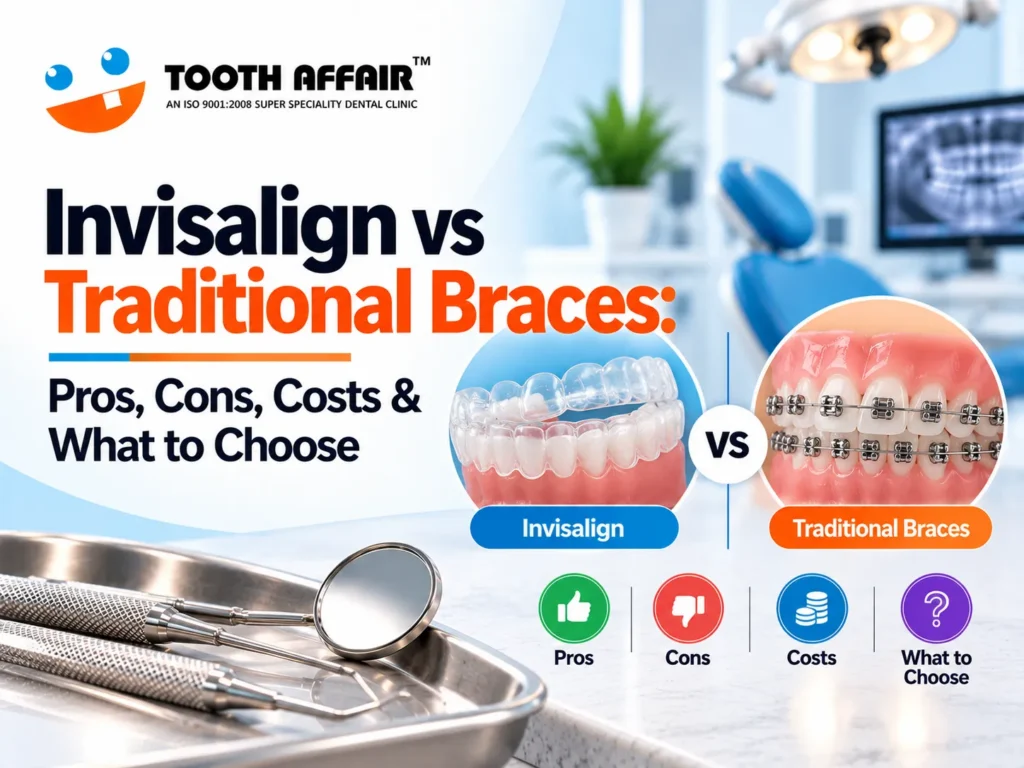
Choosing between Invisalign and traditional braces depends on your teeth alignment, bite condition, lifestyle, budget, and treatment goals. Both orthodontic options can help straighten teeth and improve your smile, but they work differently. Invisalign uses a series of clear, removable aligners, while traditional braces use fixed brackets and wires to move teeth gradually. Understanding the differences between Invisalign vs traditional braces can help you prepare for your orthodontic consultation. In this guide, we explain the features, benefits, drawbacks, treatment procedures, costs, and suitability of both options to help you understand the difference between Invisalign vs Traditional Braces and make an informed decision with your orthodontist.
Invisalign vs Traditional Braces: Definitions, Features, Pros and Cons
Before comparing these orthodontic treatments, it helps to understand how each option works. Invisalign offers a removable and discreet approach, whereas traditional braces provide continuous tooth movement through a fixed appliance. The right choice depends on your individual dental condition and the movements required to achieve the desired results.
What Is Invisalign?
Invisalign is an orthodontic treatment that uses a series of custom-made, transparent aligners to gradually move teeth into their planned positions. Each aligner applies controlled pressure to specific teeth, and patients change to the next set according to their orthodontist’s instructions.
The aligners are designed using digital scans or other dental records that help the orthodontist plan the treatment. Small tooth-colored attachments may also be placed on certain teeth to improve aligner grip and support specific movements.
Because Invisalign aligners are removable, patients can take them out while eating, drinking anything other than water, and cleaning their teeth. However, they must wear the aligners for the prescribed number of hours each day to maintain treatment progress.
What Are the Key Features of Invisalign?
Invisalign combines digital treatment planning with removable aligners to provide a discreet orthodontic option. Its features make it particularly appealing to patients who want flexibility in their daily routines.
Let’s explore its main features:
- Clear and Discreet Appearance: Invisalign aligners are transparent, making them less noticeable than conventional metal braces. This can appeal to adults and teenagers who prefer a subtle orthodontic treatment.
- Custom-Made Aligners: Each aligner is designed to fit the patient’s teeth at a particular stage of treatment. The series gradually guides the teeth toward their planned positions.
- Digital Treatment Planning: Digital scans and treatment-planning software help orthodontists map the expected tooth movements. A digital preview may be available, although actual results depend on how the teeth respond to treatment.
- Removable Design: Patients can remove their aligners for meals, brushing, and flossing. This provides flexibility that fixed braces cannot offer.
- Scheduled Aligner Changes: Patients progress through a series of aligners according to their orthodontist’s instructions. The timing depends on the treatment plan and individual response.
- Tooth-Colored Attachments When Needed: Small attachments may be bonded to selected teeth to help the aligners control particular movements. These attachments can make treatment more effective for suitable cases.
- Daily Wear Commitment: Aligners generally need to be worn for around 20–22 hours per day, or as prescribed by the orthodontist. Removing them too frequently can affect treatment progress.
What Is the Cost of Invisalign in Bangalore?
The cost of Invisalign in Bangalore generally ranges from approximately ₹1,00,000 to ₹3,00,000 or more, depending on the complexity of the alignment problem, the number of aligners required, and the treatment plan. Simple cases may cost less than complex cases that require additional aligners or refinements.
Before starting treatment, ask your orthodontist for a complete quotation covering consultation, digital scans, aligners, follow-up appointments, refinements, and retainers. The final cost depends on your individual dental condition and the clinic’s pricing.
What Are the Pros of Invisalign?
Invisalign offers several advantages for people who want to straighten their teeth without wearing fixed metal braces. Its main benefits relate to appearance, convenience, and oral hygiene.
Let’s explore these benefits in more detail:
- Less Noticeable During Treatment: The clear aligners are difficult to notice from a normal conversational distance. This can help patients feel more comfortable during professional meetings, social gatherings, and everyday interactions.
- Convenient Eating Experience: Patients can remove their aligners before meals and eat a wide variety of foods. Unlike traditional braces, there is no need to avoid particular foods specifically because they might damage brackets or wires.
- Easier Brushing and Flossing: Removing the aligners allows patients to brush and floss their teeth normally. Good cleaning habits can help reduce plaque accumulation and support healthier gums during orthodontic treatment.
- Potentially Fewer Adjustment Visits: Some Invisalign treatment plans involve fewer in-office appointments than conventional braces. However, the frequency of visits depends on the case, monitoring requirements, and the orthodontist’s instructions.
- Smooth Aligner Surfaces: The aligners generally have smooth plastic surfaces without the protruding brackets and wires found in traditional braces. This may reduce some types of soft-tissue irritation, although temporary discomfort can still occur.
- Greater Flexibility for Special Occasions: Patients can remove aligners briefly when necessary, provided they follow their orthodontist’s instructions and maintain the required daily wear time. This flexibility can be helpful for important events and selected activities.
- Digital Treatment Visualization: Digital planning can help patients understand the intended tooth movements and discuss the treatment goals before beginning. The preview represents a planned outcome rather than a guarantee of the final result.
- Suitable for Many Common Alignment Problems: Invisalign can address various conditions, including crowding, spacing, and selected bite problems. Suitability depends on the complexity of the case and the orthodontist’s assessment.
What Are the Cons of Invisalign?
Although Invisalign provides flexibility and a discreet appearance, it also requires discipline and may not be suitable for every orthodontic condition. Patients should understand these limitations before choosing treatment.
Let’s examine the main drawbacks:
- Requires Consistent Daily Wear: Invisalign aligners generally need to remain in place for approximately 20–22 hours daily. Patients who frequently remove them or forget to wear them may experience slower progress or an unsatisfactory treatment result.
- May Not Suit Every Complex Case: Some severe bite problems and complicated tooth movements may be managed more predictably with fixed braces or a combination of orthodontic techniques. An orthodontist must assess the specific condition before recommending aligners.
- Risk of Losing Aligners: Because the aligners are removable, patients can accidentally lose or damage them. Replacement may involve additional expenses and could disrupt the treatment schedule.
- Requires Regular Cleaning: Aligners need appropriate cleaning to prevent plaque buildup, unpleasant odors, and staining. Patients must also clean their teeth before reinserting the aligners whenever possible.
- Temporary Speech Changes: Some patients notice a slight lisp or change in pronunciation when they first start wearing aligners. This usually improves as they adapt, although the adjustment period varies.
- May Require Additional Attachments: Certain tooth movements require attachments or other orthodontic auxiliaries. These can make the treatment more noticeable and may introduce additional areas that need careful cleaning.
- Can Be More Expensive: Invisalign may cost more than some traditional braces options, depending on the provider, treatment complexity, and aligner system. A personalized quotation is necessary to compare the complete cost.
- Discomfort Can Still Occur: Patients may experience pressure, tenderness, or temporary discomfort when starting a new set of aligners. Clear aligners should not be assumed to be completely painless.
What Are Traditional Braces?
Traditional braces are fixed orthodontic appliances that gradually move teeth using brackets, archwires, and other components. The brackets are attached to the teeth, and the wire applies controlled forces that guide teeth into their intended positions over time.
Orthodontists periodically assess progress and adjust the appliance according to the treatment plan. Unlike Invisalign, traditional braces remain attached throughout active treatment and cannot be removed by the patient.
Metal braces are a common option, while ceramic braces offer a less noticeable alternative using tooth-colored or clear brackets. The most appropriate type depends on the patient’s dental condition, aesthetic preferences, and budget.
What Is the Cost of Traditional Braces in Bangalore?
The cost of traditional braces in Bangalore may range from approximately ₹30,000 to ₹1,20,000 or more, depending on the type of braces, treatment complexity, and expected duration. Conventional metal braces are often more affordable, while ceramic braces may cost more.
Ask your orthodontist whether the quoted price includes diagnostic tests, regular adjustments, emergency visits, and retainers after treatment. Comparing the complete treatment cost helps you understand the actual expense before choosing between traditional braces and Invisalign.
What Are the Key Features of Traditional Braces?
Traditional braces use a fixed system to guide teeth throughout treatment. Their design gives orthodontists considerable control over tooth positioning and makes them suitable for many different alignment and bite problems.
Let’s explore their main features:
- Fixed Orthodontic Appliance: Brackets remain attached to the teeth during active treatment. The appliance continues applying controlled forces without requiring patients to remember to insert aligners.
- Metal Brackets and Archwires: Conventional braces use brackets connected by an archwire. Adjustments to the wire and other components help the orthodontist guide teeth through planned movements.
- Ceramic Alternatives: Ceramic braces use tooth-colored or clear brackets that may be less noticeable than metal options. Their appearance and maintenance requirements differ from those of conventional metal braces.
- Continuous Tooth Movement: Because braces remain in place, they work throughout the day and night according to the treatment plan. Patients do not need to manage daily wear hours.
- Regular Orthodontic Adjustments: Follow-up appointments allow the orthodontist to evaluate tooth movement, modify the appliance, and address problems such as loose brackets or damaged wires.
- Control Over Complex Movements: Fixed braces can provide effective control over many challenging tooth movements and bite corrections. The treatment approach depends on the individual orthodontic problem.
- No Removable Trays to Manage: Patients do not need to store, remove, or replace a series of aligners. However, they must take care to avoid damaging the fixed appliance.
What Are the Pros of Traditional Braces?
Traditional braces have a long history of use in orthodontics and can be effective for a wide range of alignment problems. Their fixed design and ability to control complex movements are important advantages.
Let’s examine their main benefits:
- Suitable for Complex Orthodontic Cases: Traditional braces can manage many complicated alignment and bite problems, including cases requiring precise control over tooth position. The orthodontist can select the appropriate mechanics for the condition.
- No Daily Wear-Time Management: Since braces are fixed, patients do not need to remember to wear aligners for a specific number of hours. This can be helpful for people who may struggle with consistent aligner use.
- Effective Throughout the Day: The appliance remains in place during meals, sleep, work, and other daily activities. Treatment therefore does not depend on patients repeatedly inserting and removing a removable device.
- Multiple Material Options: Patients may choose between metal and ceramic braces when clinically appropriate. This allows some flexibility in balancing appearance, cost, and treatment requirements.
- Established Treatment Method: Traditional braces have been used for decades, and orthodontists have extensive experience with their application. Their established techniques make them a dependable option for many patients.
- No Risk of Losing Removable Aligners: Because the brackets and wires are attached to the teeth, patients cannot accidentally misplace the entire orthodontic appliance in the way they might lose a removable aligner.
- Can Address a Broad Range of Dental Problems: Fixed braces can treat crowding, spacing, rotations, and many bite irregularities. The exact treatment possibilities depend on the severity of the problem and the overall dental condition.
What Are the Cons of Traditional Braces?
Traditional braces can deliver effective results, but their fixed design creates some practical challenges. Patients need to consider appearance, food choices, cleaning requirements, and the possibility of irritation or appliance damage.
Let’s explore these drawbacks:
- More Noticeable Appearance: Metal brackets and wires are generally visible when speaking or smiling. This may concern patients who prefer a discreet orthodontic treatment.
- Initial Discomfort and Irritation: Teeth may feel tender after braces are fitted or adjusted. Brackets and wires can also irritate the cheeks, lips, and other soft tissues, especially during the adjustment period.
- Food Restrictions: Hard, sticky, and chewy foods can damage brackets or bend wires. Patients need to adjust their eating habits and follow the orthodontist’s advice to reduce the risk of appliance damage.
- More Challenging Oral Hygiene: Food particles and plaque can collect around brackets and wires. Careful brushing, appropriate interdental cleaning, and regular dental monitoring are important for reducing the risk of tooth decay and gum inflammation.
- Regular Adjustment Appointments: Traditional braces usually require periodic appointments to monitor progress and adjust the appliance. The frequency depends on the treatment plan and clinical requirements.
- Possibility of Broken Components: Brackets can loosen, and wires can bend or cause irritation. Damaged components may require an additional appointment to restore the appliance and maintain treatment progress.
- Temporary Eating and Speaking Adjustments: Patients may need time to become comfortable chewing and speaking with braces. Certain activities, such as playing contact sports or wind instruments, may also require additional precautions.
- Visible Changes With Some Materials: Metal braces remain noticeable, while ceramic braces may stain or become discolored under certain conditions. Careful cleaning and adherence to professional advice help maintain their appearance.
What Are the Top 10 Key Differences Between Invisalign vs Traditional Braces?
The main difference between Invisalign and traditional braces is how each treatment moves teeth and fits into daily life. Invisalign uses removable clear aligners, while traditional braces use a fixed system of brackets and wires.
The following comparison covers the factors that matter most when choosing an orthodontic treatment.
| Comparison factor | Invisalign | Traditional braces |
| Appearance | Clear and less noticeable | Metal braces are more visible; ceramic options are less noticeable |
| Design | Removable custom-made aligners | Fixed brackets and archwires |
| Removability | Removed for meals and cleaning | Remain attached during treatment |
| Oral hygiene | Brushing and flossing are generally easier | Requires additional care around brackets and wires |
| Food choices | Aligners are removed before eating | Some hard, sticky, and chewy foods should be avoided |
| Treatment control | Effective for suitable cases, depending on aligner mechanics | Effective for a broad range of movements and complex cases |
| Compliance | Requires consistent daily wear | Does not depend on daily insertion and removal |
| Appointments | May involve fewer visits in some plans | Usually requires periodic adjustments |
| Comfort | Smooth surfaces; pressure and tenderness can still occur | Pressure, bracket irritation, and wire-related discomfort may occur |
| Cost | May cost more depending on the treatment plan | Cost varies by material, complexity, and provider |
What Are the Top 10 Key Differences Between Invisalign vs Traditional Braces?
Invisalign and traditional braces differ in appearance, design, comfort, maintenance, treatment duration, and cost. Understanding these differences can help you compare both options and discuss the most suitable treatment with your orthodontist.
Appearance and Visibility
Invisalign uses transparent aligners that fit over the teeth, making them less noticeable during everyday activities. Traditional metal braces use visible brackets and wires, while ceramic braces offer a less noticeable alternative. Invisalign may be preferable for patients who prioritize a discreet appearance.
Design and Treatment Mechanism
Invisalign gradually moves teeth using a series of custom-made, removable aligners. Traditional braces use brackets attached to the teeth and an archwire to apply controlled forces. The orthodontist selects the appropriate treatment based on the tooth movements required and the patient’s dental condition.
Oral Hygiene and Cleaning
Invisalign aligners can be removed for brushing and flossing, making routine oral hygiene easier. Traditional braces require careful cleaning around brackets and wires, where plaque and food particles can accumulate. Both treatments require consistent oral hygiene to help prevent cavities and gum problems.
Food Choices and Eating Habits
Invisalign aligners are removed before meals, allowing patients to enjoy a wide range of foods without risking damage to the appliance. Traditional braces require avoiding certain hard, sticky, and chewy foods that may loosen brackets or damage wires. Both options require patients to follow their orthodontist’s instructions.
Suitability for Complex Dental Problems
Traditional braces can provide effective control over many complex tooth movements and bite corrections. Invisalign can also address various alignment problems, including selected complex cases. The most appropriate option depends on the severity of the dental issue, the movements required, and the orthodontist’s clinical assessment.
Patient Compliance and Daily Responsibility
Invisalign generally requires wearing aligners for approximately 20–22 hours per day, or as directed by the orthodontist. Removing them too frequently may delay progress. Traditional braces remain fixed to the teeth, eliminating the need to manage daily wear hours, although patients must maintain good oral hygiene and follow dietary instructions.
Appointment Frequency and Adjustments
Invisalign appointments typically involve checking progress, assessing aligner fit, and planning subsequent stages. Some treatment plans may require fewer visits. Traditional braces generally require periodic appointments to adjust the appliance and monitor tooth movement. The actual frequency depends on the treatment plan and individual progress.
Comfort and Discomfort
Invisalign aligners have smooth surfaces that may reduce irritation from brackets and wires. However, patients can experience pressure or tenderness when starting a new set of aligners. Traditional braces may cause soreness after adjustments or irritation to the cheeks and lips. Comfort varies between individuals, and neither treatment is completely pain-free.
Treatment Duration
The duration of Invisalign or traditional braces treatment depends on the complexity of the alignment problem, the required tooth movements, and the patient’s response to treatment. Some Invisalign cases may finish within several months, while others take longer. Traditional braces also vary in duration, so neither option is always faster.
Treatment Cost and Overall Expenses
Invisalign may cost more than conventional metal braces in some cases, depending on the aligner system and treatment complexity. Traditional braces may be more economical, although ceramic options can cost more. When comparing prices, consider consultation fees, diagnostic tests, follow-up appointments, refinements or repairs, and retainers after treatment.
Should You Choose Invisalign First or Traditional Braces?
The right treatment depends on your orthodontic needs, daily habits, aesthetic preferences, and ability to follow professional instructions. Instead of assuming one option is better for everyone, consider the situations in which each treatment may be appropriate.
Choose Invisalign First If?
Invisalign may be worth discussing with your orthodontist if you want a discreet treatment and can commit to wearing removable aligners consistently.
Consider Invisalign if:
- You Prefer a Discreet Treatment: Clear aligners are less noticeable than metal braces. They may be suitable if you feel self-conscious about wearing visible orthodontic appliances at work, college, or social events.
- You Want to Maintain Your Usual Eating Habits: You can remove Invisalign aligners before meals. This allows greater flexibility with food choices, provided you follow the recommended cleaning and wear routine.
- You Value Easier Oral Hygiene: Removing aligners allows you to brush and floss normally. This can make everyday cleaning more convenient compared with cleaning around fixed brackets and wires.
- You Can Follow a Consistent Routine: Invisalign requires disciplined daily wear. It may suit you if you can remember to reinsert your aligners after meals and follow your orthodontist’s instructions.
- Your Dental Condition Is Suitable: Invisalign can address many common alignment issues and selected bite problems. An orthodontist must confirm that the required tooth movements can be achieved predictably with aligners.
- You Prefer Fewer Appliance-Related Food Restrictions: You can remove the aligners while eating instead of modifying your diet to protect brackets and wires.
Choose Traditional Braces If?
Traditional braces may be worth discussing if your case requires complex tooth movements or you prefer an appliance that works without daily insertion and removal.
Consider traditional braces if:
- You Have Complex Alignment or Bite Problems: Fixed braces can manage many challenging orthodontic conditions. Your orthodontist can determine whether their mechanics are more suitable for your particular case.
- You May Struggle With Aligner Wear: Braces remain attached to your teeth throughout treatment. This removes the need to remember to wear aligners for a prescribed number of hours.
- You Prefer a Fixed Treatment Method: Traditional braces continue working without being removed for meals or cleaning. You still need to follow your orthodontist’s instructions and attend regular appointments.
- You Want to Explore Different Braces Options: Metal and ceramic braces provide different choices in terms of visibility and cost. Your orthodontist can explain which options are suitable for your treatment.
- Your Budget Is a Major Consideration: Conventional metal braces may be more affordable than Invisalign in some cases. Compare the complete fees for all suitable options before making a decision.
- You Need Detailed Orthodontic Control: Fixed braces can be effective when treatment requires precise control over particular tooth movements. Their suitability depends on the clinical requirements rather than complexity alone.
Get a Professional Recommendation Before Deciding
Online comparisons can help you understand the options, but they cannot determine which treatment is appropriate for your teeth. An orthodontist can assess your dental condition and recommend an option based on clinical findings.
During your consultation, ask the orthodontist to explain the advantages and limitations of each suitable treatment. If both options are appropriate, compare their costs, daily requirements, estimated duration, and likely outcomes before making your decision.
Are Invisalign and Traditional Braces Safe?
Both Invisalign and traditional braces are established orthodontic treatment options when appropriately prescribed and monitored by a qualified dental professional. However, neither option is entirely free from risks or side effects.
Invisalign may cause temporary pressure, tenderness, or irritation. Traditional braces may cause tooth soreness, soft-tissue irritation, and difficulty cleaning around brackets and wires. In either case, poor oral hygiene can increase the risk of dental problems during treatment.
A professional assessment is important before starting orthodontic treatment. Your dentist or orthodontist should review your teeth, gums, bite, and relevant dental history to identify any concerns that need attention.
To support safe treatment:
- Follow the prescribed wear schedule or appliance-care instructions.
- Maintain good oral hygiene throughout treatment.
- Attend scheduled orthodontic appointments.
- Contact your orthodontist if an appliance breaks, causes persistent irritation, or does not fit as expected.
- Complete the recommended retention phase after active treatment.
The safest choice is the option that is clinically appropriate for your dental condition and can be managed properly throughout treatment.
Does Invisalign Hurt More or Less Than Traditional Braces?
Neither Invisalign nor traditional braces guarantees a completely pain-free experience. Both apply pressure to move teeth, which can cause temporary soreness, particularly when treatment begins or the appliance is adjusted.
Invisalign may cause pressure when you start a new set of aligners. Traditional braces may cause tenderness after adjustments, while brackets and wires can irritate the cheeks and lips.
The amount of discomfort varies between individuals. It can depend on the amount of tooth movement, the appliance, and personal sensitivity.
To manage discomfort, follow your orthodontist’s advice, eat softer foods when your teeth feel tender, and avoid trying to adjust the appliance yourself. Seek professional guidance if the pain is severe, persistent, or accompanied by swelling or other concerning symptoms.
Conclusion: Which Is Better, Invisalign or Traditional Braces?
Choosing between Invisalign and traditional braces requires careful consideration of your dental condition, lifestyle, budget, and treatment goals. Invisalign offers a discreet, removable option that makes eating and routine oral hygiene more convenient. Traditional braces provide a fixed appliance that can manage a broad range of orthodontic problems, including many complex tooth movements.
Neither option is universally better. The most suitable treatment depends on your alignment issues, bite, oral health, ability to follow treatment instructions, and the orthodontist’s assessment.
Before making a decision, compare the complete treatment costs, expected duration, daily care requirements, and retention plan. A professional consultation will help you understand which option is appropriate for achieving a healthier, straighter smile.
Get Professional Dental Care at Tooth Affair in Bangalore
If you are considering Invisalign or traditional braces, Tooth Affair can be a starting point for discussing your orthodontic needs and understanding the treatment options available for your smile.
When evaluating your options, look for a dental team that can assess your alignment concerns, explain the differences between clear aligners and fixed braces, and help you understand the treatment process, expected costs, and follow-up requirements.
Whether you are concerned about crowded teeth, gaps, bite alignment, or the appearance of your smile, seek an individualized assessment before choosing an orthodontic treatment.
Visit Tooth Affair to learn more about dental care in Bangalore and enquire about the orthodontic options appropriate for your needs.
FAQs About Invisalign vs Traditional Braces
Which Is Better, Invisalign or Traditional Braces?
Neither option is better for every patient. Invisalign may suit people who prefer removable, discreet aligners and can follow the prescribed wear schedule. Traditional braces may be more suitable for certain complex tooth movements. An orthodontist can assess your alignment problems, bite, and oral health before recommending the right treatment.
Is Invisalign More Expensive Than Traditional Braces?
Invisalign may cost more than conventional metal braces, but the difference depends on treatment complexity, the provider, location, and the appliance selected. Ceramic braces may also have different pricing from metal braces. Request a detailed quotation covering diagnostics, follow-up appointments, refinements, and retainers before comparing the total treatment cost.
Is Invisalign Less Painful Than Traditional Braces?
Some patients find Invisalign more comfortable because the aligners have smooth surfaces and do not use conventional brackets and wires. However, aligners can cause pressure and tenderness, especially when changing to a new set. Traditional braces can also cause temporary soreness after fitting or adjustments. Individual experiences vary.
How Long Does Invisalign Treatment Take Compared With Braces?
Treatment duration depends on the complexity of your dental condition, the movements required, and your response to treatment. Some Invisalign cases may finish within several months, while others take longer. Traditional braces also vary in duration. Your orthodontist can provide a more useful estimate after examining your teeth and developing a treatment plan.
Can Invisalign Fix Severe Teeth Crowding?
Invisalign can correct many crowding problems, including some complex cases. However, its suitability depends on the amount of crowding, the required tooth movements, and other dental factors. Certain cases may respond more predictably to traditional braces or a combined approach. An orthodontist must evaluate your teeth before recommending treatment.
Can I Switch From Traditional Braces to Invisalign?
Switching from traditional braces to Invisalign may be possible in selected cases. Your orthodontist will assess your treatment progress, remaining tooth movements, and whether aligners can achieve the required result. Switching is not suitable for every patient and may affect the treatment timeline or cost. Do not change appliances without professional guidance.
Can I Eat Normally With Invisalign?
You can generally eat a wide variety of foods with Invisalign because the aligners are removed before meals. You should not eat with the aligners in place unless your orthodontist specifically instructs otherwise. Clean your teeth before reinserting them whenever possible, and follow the instructions for cleaning and storing the aligners.
Are Traditional Braces Suitable for Adults?
Yes. Traditional braces can be suitable for adults who want to correct crowded teeth, gaps, or bite problems. Age alone does not determine whether orthodontic treatment is appropriate. The condition of your teeth, gums, supporting bone, and overall oral health helps determine which treatment options are suitable.
Are Invisalign and Traditional Braces Safe for Teeth?
Both treatments can be used safely when appropriately planned and monitored. However, inadequate oral hygiene can increase the risk of cavities, gum inflammation, and other dental problems during orthodontic treatment. Attend regular appointments, follow cleaning instructions, and report persistent pain or appliance problems to your orthodontist.
Do I Need to Wear Retainers After Invisalign or Traditional Braces?
Yes, retainers are commonly recommended after either treatment to help maintain the corrected tooth positions. Teeth can shift after braces or aligners are removed, so following the prescribed retention plan is important. Your orthodontist will explain the type of retainer, how often to wear it, and how to care for it over time.